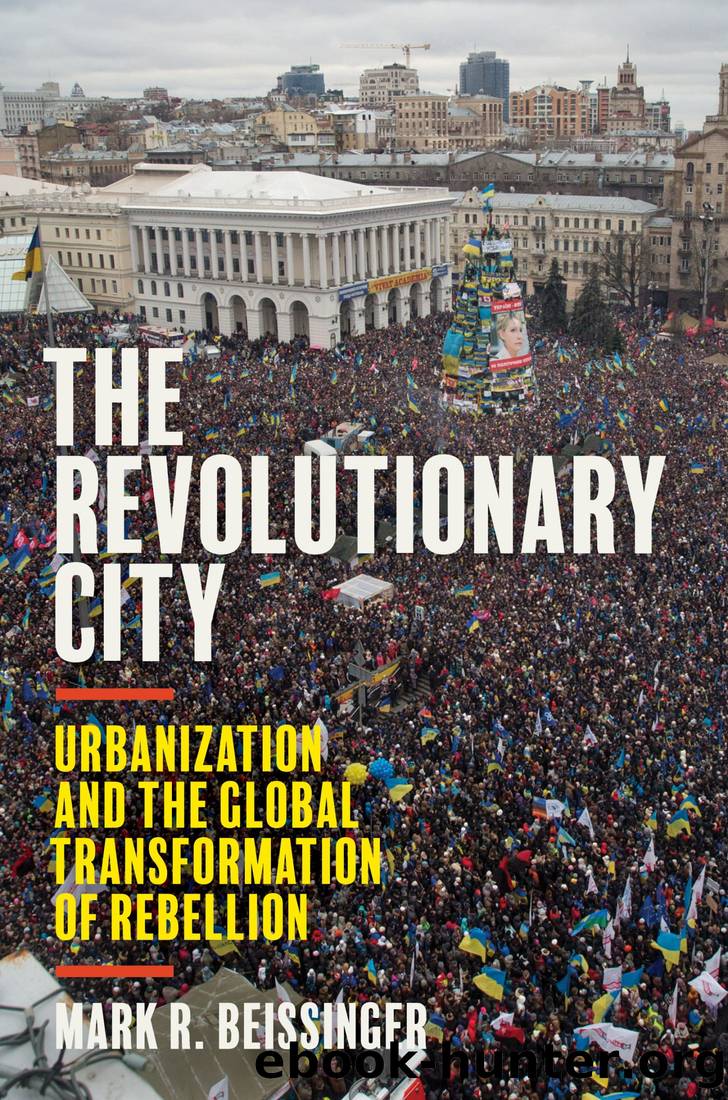
The Revolutionary City by Mark R. Beissinger
Author:Mark R. Beissinger [Beissinger, Mark R.]
Language: eng
Format: epub
ISBN: 9780691224749
Publisher: Princeton UP
Published: 2022-01-24T00:00:00+00:00
These behavioral categories for the Tunisian and Egyptians revolutions are shown in Figure 7.2. As a proportion of the population, participation rates in the Tunisian Revolution were significantly greater than in the Egyptian Revolutionâeven though, as noted in the media at the time, the size of protests in Egypt far exceeded those in Tunisia. Differences in population size between the two countries largely explain this (Tunisia had a population of 10.7 million at the time of the revolution, whereas Egyptâs population was 82.5 million). According to the surveys, the proportion of revolution supporters was roughly similar in both societies, whereas Egypt had more respondents who admitted to being revolution opponents.32
Preference falsification is an issue in all four surveys, leading to an understatement of opposition to these revolutions and of counterrevolutionary activity more generally. The fact that all four revolutions were successful mitigated the risks associated with identifying oneself as a participant. But it created incentives to conceal opposition to these revolts and to overstate the degree to which one supported them. A nationally representative survey taken in the midst of the Orange Revolution gives some sense of the magnitude of the problem in Ukraine. Conducted by the Kyiv International Institute of Sociology (KIIS) over December 10â14, 2004,33 the survey was a âbare-bonesâ instrument focused almost entirely on voting and protest behavior, asking respondents whether they had participated in revolutionary demonstrations and their electoral preferences in the upcoming third round of the presidential election. As the survey was carried out prior to the third round of voting and the final outcome of the revolution, it may be a more accurate reflection of who participated in revolutionary protests but a less accurate reflection of individual regime preferences (12.2 percent of the sample said that they were likely to vote but did not know yet for whom or indicated no electoral preference). The KIIS survey found a lower proportion of revolutionaries (13.6 percent) than the Monitoring survey (15.6 percent)âbut within the margin of error of both surveys.34 But it also reported a significantly lower proportion of revolution supporters (26.9 percent in the KIIS survey versus 36.2 percent in the Monitoring survey)35 and somewhat higher proportions of revolution opponents (35.6 percent versus 31.5 percent)36 and counterrevolutionaries (4.0 percent versus 2.1 percent).37 Some of these differences could have been due to different sampling strategies in the two surveys. However, the patterns also fit what one would expect to find under conditions of preference falsification.
The likelihood is that both surveys involve an element of preference falsification. In the retrospective Monitoring survey, the effect is to inflate the number of revolution supporters and to deflate the number of revolution opponents and counterrevolutionaries. In the Monitoring survey, 62 percent of those who claimed to have voted in the third round of the 2004 presidential election indicated that they voted for Yushchenko, even though the official results of the election showed that Yushchenko received only 52 percent of the vote. In the KIIS survey, however, only 43 percent of
Download
This site does not store any files on its server. We only index and link to content provided by other sites. Please contact the content providers to delete copyright contents if any and email us, we'll remove relevant links or contents immediately.
| Anthropology | Archaeology |
| Philosophy | Politics & Government |
| Social Sciences | Sociology |
| Women's Studies |
The Secret History by Donna Tartt(19086)
The Social Justice Warrior Handbook by Lisa De Pasquale(12190)
Thirteen Reasons Why by Jay Asher(8909)
This Is How You Lose Her by Junot Diaz(6886)
Weapons of Math Destruction by Cathy O'Neil(6279)
Zero to One by Peter Thiel(5801)
Beartown by Fredrik Backman(5754)
The Myth of the Strong Leader by Archie Brown(5507)
The Fire Next Time by James Baldwin(5442)
How Democracies Die by Steven Levitsky & Daniel Ziblatt(5218)
Promise Me, Dad by Joe Biden(5153)
Stone's Rules by Roger Stone(5087)
A Higher Loyalty: Truth, Lies, and Leadership by James Comey(4962)
100 Deadly Skills by Clint Emerson(4925)
Rise and Kill First by Ronen Bergman(4788)
Secrecy World by Jake Bernstein(4753)
The David Icke Guide to the Global Conspiracy (and how to end it) by David Icke(4717)
The Farm by Tom Rob Smith(4507)
The Doomsday Machine by Daniel Ellsberg(4490)
